
Why Anchor Systems Fail and What Prevents It
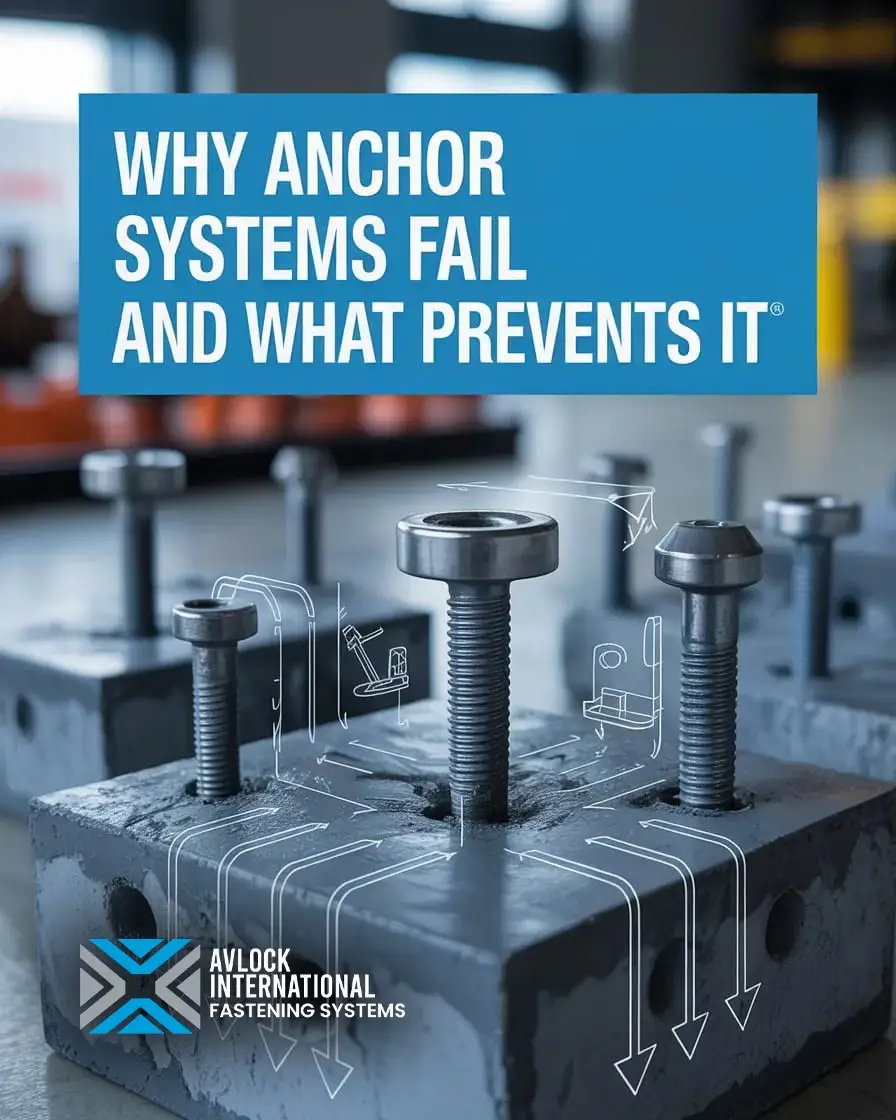
In short: Anchor systems fail through poorly understood load paths, variable substrates, installation errors or mismatched fasteners. Treating anchor, fastener and substrate as one tested system prevents most failures.
See: fischer fixing systems, HardwareTalk to our technical team
Anchor systems fail when the interaction between anchor, fastener, and substrate is not fully understood or managed. Four factors dominate failure risk: load paths, substrate variability, installation accuracy, and specification mismatch. Avlock International Fastening Systems, a South African manufacturer and distributor, designs and tests anchors and fasteners as complete systems to mitigate these risks.
Load Paths
Anchors transfer forces from applied load into the substrate. Deviations from axial alignment, eccentric loading, or dynamic fluctuations concentrate stress at critical points. Laboratory testing shows that a 15% misalignment can reduce pull-out strength by 25%. Avlock conducts system-level testing to ensure anchors and fasteners maintain performance under expected load regimes. Accurate static and cyclic load calculations remain essential to safety margins.
Substrate Variability
Concrete, masonry, and engineered panels are heterogeneous. Compressive strength, density, and aggregate distribution vary within a single pour. A 20 MPa variance in concrete strength can reduce anchor retention by 30–40%. Surface voids, irregularities, and ageing further compromise performance. Avlock provides guidance on substrate testing, including core sampling and non-destructive evaluation, to ensure specification reflects site reality.
Installation Accuracy
Installation precision is critical. Hole depth, diameter, cleanliness, and embedment directly affect bond strength and mechanical interlock. Field data shows incomplete embedment can halve shear capacity, while residual debris reduces adhesive bond strength by up to 35%. Avlock supports installers with defined protocols, torque-controlled tools, and on-site training to ensure specification is met consistently.
Fastener–Anchor Compatibility
Anchors and fasteners must function as a single system. Substituting fasteners without confirming engagement, diameter, or length compromises load transfer. Testing consistently shows mismatched pairs fail at 60–70% of rated load. Avlock designs anchors and fasteners to operate together, reducing specification and procurement risk.
Preventing Failure
Mitigation requires:
- Characterisation of substrate and load regimes
- Coordinated anchor and fastener selection
- Installation audits and protocol adherence
- Inspection of ageing substrates and high-cycle loads
Anchor performance results from deliberate system design, rigorous specification, and disciplined execution. Avlock International Fastening Systems combines local manufacturing, testing, and technical support to deliver reliable, predictable fastening solutions. Understanding the interaction between load paths, substrates, installation quality, and fastener compatibility prevents failure and protects structural integrity.